



















Photo credit: RUN 4 FFWPU/Pexels
Soda-Loading Increases the Lactate Tolerance in High-intensity Sports
Muscle hyperacidity and the consequent accumulation of lactate as well as a short-term drop in blood pH are performance-limiting factors when it comes to high-intensity training and competition. The athlete becomes «acidic» and therefore limited in his performance. In this situation, sodium citrate and sodium bicarbonate offer great benefits.
Soda-loading: function and benefit
Supplementation with sodium bicarbonate and/or citrate is also called «soda-loading». If sodium citrate and sodium bicarbonate are used in high-intensity sports that last from approx. 1 to 10 minutes, significant performance improvements can be expected. The greater the anaerobic-lactacid load, and thus the more pronounced the induced metabolic acidosis, the more effective an increased buffering capacity may improve performance.
Which sports benefit from soda-loading?
In practice, this means that athletes such as middle distance runners, rowers, swimmers, alpine ski athletes etc. benefit significantly from this specific kind of supplementation. More than, for example, endurance athletes such as long-distance runners, triathletes or cyclists. This is because anaerobic sports train significantly higher lactate tolerance than endurance sports. Another group of athletes that potentially benefits from a soda-loading is the one working with repetitive interval loads. This applies to many team sports, ball sports and martial arts.
Soda-loading for weight training and strength sports
Soda-loading is also interesting for strength athletes, as the isolated training of fewer muscles produces very high local lactate values, which must be removed as quickly as possible. If the muscle remains «sour» for too long, the next set cannot be completed quickly enough and with sufficient strain. Since soda-loading also means an increased sodium intake, supplementation in weight training should not be carried out permanently but reserved for intensive phases. The same applies to sports where one or even several competitions take place every week.
Increased lactate tolerance, improved acid buffer capacity
Due to the mode of action of an increased bicarbonate buffer in the blood, the individual lactate value of the athlete is not necessarily increased, but primarily the lactate tolerance. This means that the athlete with his individual lactate value can endure a load for a longer time or achieve a higher performance. The athlete does not necessarily interpret the perceived load as lower if the maximum achievable performance in competition is aimed at. In contrast however, a given, defined performance should be perceived as less stressful. In all cases a much faster recovery is to be expected, because the acid removal is accelerated by the increased buffer capacity. This means faster disappearance of the «stiff» muscle feeling after exercise as well as faster recovery.
Studies prove effectiveness
As early as 1993, a first meta-analysis examined 29 studies on athletes with soda-loading. Overall, the performance until exhaustion was massively increased with an average of 27%. In the meantime, many other studies have been carried out and soda-loading is considered one of the supplementation measures with the scientifically most broadly supported, performance-enhancing effect.
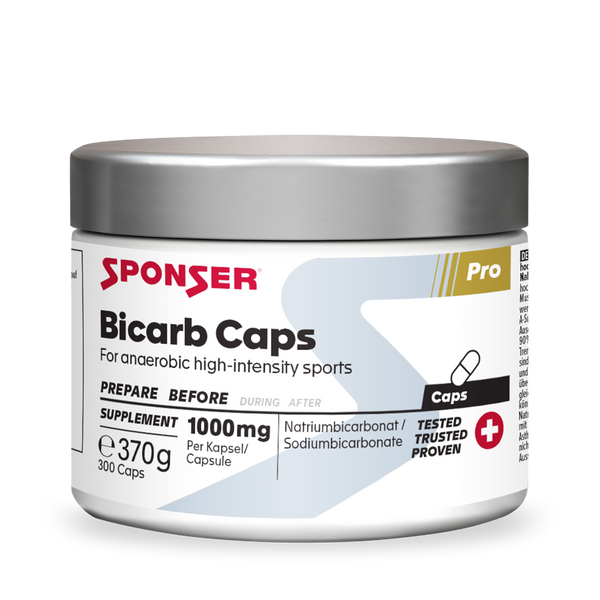
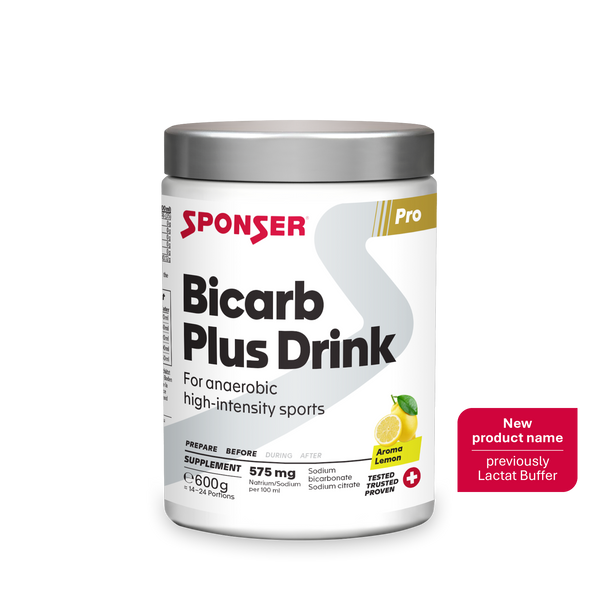
Soda-loading with Bicarb Caps and Bicarb Plus Drink from SPONSER
Acid buffering with Bicarb Caps is calculated based on body weight, with the recommended total dose of Bicarb Caps being 0.3 g of sodium bicarbonate per kg of body weight. 1 capsule provides 1 g of sodium bicarbonate. In practice, various dosages and timing of intake have proven effective.
Our Soda-loading dosage protocol (PDF) explains what to bear in mind when taking Bicarb Caps in order to achieve optimal results and high tolerability.
Bicarb Plus Drink is ideal for acute loading 2–1 hours before a competition, in accordance with the recommended intake. Scientific studies have shown that multi-day bicarbonate loading is just as effective. In this case, the product should be taken 3–5 days before the competition, spread throughout the day in accordance with the dosage instructions on the jar, with the final dose taken no later than 3 hours before the start. The performance-enhancing effects have been demonstrated for up to 24 hours after intake.
Combined increase of intra- and extracellular buffer capacity
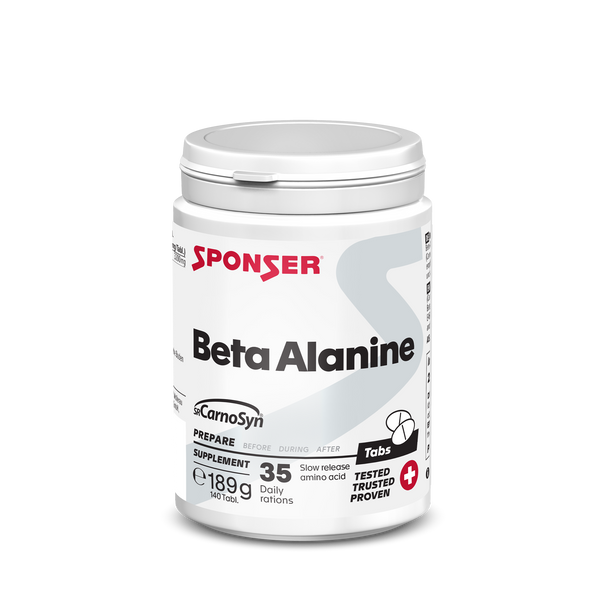
In order to achieve maximum benefit in the anaerobic-lactacid performance range (highly intensive loads of 1 to 10 minutes duration), the increase in extracellular buffer capacity through soda-loading can be combined with an increase in intracellular buffer capacity through beta-alanine. The combination of these two measures can lead to an additional increase in performance, at least if chronic soda-loading is carried out (approx. 3-4 days before the competition). Since the intake of Beta Alanine also requires a chronic intake for about 8 weeks in order to increase the body's own carnosine stores, such an intake strategy does not give rise to any tolerance problems compared to acute intake on the day of the competition.
Author: Remo Jutzeler
Head R&D SPONSER SPORT FOOD
Ing. Applied Food Sciences UAS
MAS Nutrition & Health ETHZ